Today I have a really exciting new pattern collection to show all of you: the Holla Knits Crochet Collection! If you've been following me, then you should be no stranger to the awesomeness that is Holla Knits. I reviewed the Fall/Winter 2012 collection and the Accessories 2012 collection previously, and my yarn was even featured in the Wallpaper Cowl pattern last year.
I'm excited to say that Gynx Yarns is back with the latest Holla Knits collection and I'm going to have a giveaway, but more about that at the end of this post. First, let's look at the patterns:
Granny Square Earrings and Ring by Casey Carroll
This set of ring and earrings (not pictured) would make such a fun and speedy gift for someone! I love how big the ring is and I think it's a great way to show off your yarn-y pride even when it's miserably hot outside.
Betty...Betty Grable by Rohn Strong
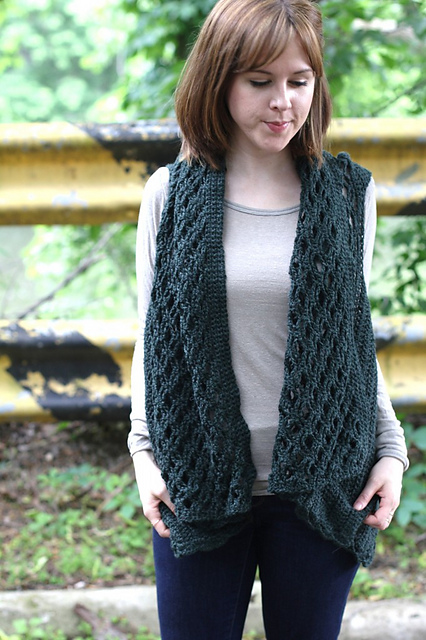
This summery vest is shown in a single color option (above) and a three-color option, and I can't decide which one I like more. I adore big vests, and if I were to wear it, I think it would look great belted at the waist.
Prim by Ann Leachman
I think the name of this pattern says it all. Perfect for the girly girl who loves collars (and the ability to change them!).
County Fair Scarf by Claire A. Denny
The shape of this is like a combination of a scarf and a kerchief. The shape of it allows it to lay beautifully and I think would make an awesome closet staple for times where you want a shawl but don't want to mess with getting it to stay on.
Deco Daisies by Michele Moskaluk
This cowl makes me want to try crochet again. It's that perfect length where you can drape it over yourself as pictured or double it up for more warmth.
Cute Girl Squares Tank by Allyson Dykhuizen
And finally, the tank that my yarn was used for! The green version of this tank is knit out of my Merino Sock base in the Cactuar colorway (which is the same color I'm knitting my Featherweight out of). What I love about this pattern is how easy it is to customize. Crochet it in a solid color like the version using my yarn and then the texture becomes the star of the tank, or have fun playing with color like in the second version. The first version is also shown with a bit of negative ease, while the multi-colored version is shown with a bit of positive ease (how I'd probably wear it). Whichever way you choose to crochet it, it is a very unique and fun warm weather piece (although, who's saying you couldn't layer it for the cooler weather?)
Now, for the giveaway! Allyson is generously letting me give away a copy of the Cute Girl Squares Tank to one of you lucky readers! All you have to do is leave a comment on this post letting me know which of the patterns you want to start first. Make sure you leave me your Ravelry name or another way to contact you. Contest will run through Tuesday, July 30 and a winner will be drawn via random number generator on Wednesday, July 31.
Check out the rest of the blog tour for more fun and giveaways!
July 9: The Sweatshop of Love
July 10: Rohn Strong Designs
July 11: Casey Carroll
July 12: Lion Brand Blog
July 15: Knits in Class
July 16: Claire Denny
July 17: Be Sweet Yarn
July 18: Stash the KP Staff Blog
July 19: Magical Grammar
July 23: Gynx Yarns
July 25: Kalanag
July 26: Casey Carroll & Knit Picks Curio relaunch
Showing posts with label crochet. Show all posts
Tuesday, July 23, 2013
Saturday, July 16, 2011
Unraveling a Sweater Part 1: Picking a Sweater (Fiber)
I said I was going to have pictures of my tank top, but I haven't gotten around to it. I wore it when Jose and I took our engagement photos, so when I get those back I'll post some!
I have been asked by several people how they can recycle sweaters to use the yarn for their projects. There are several tutorials out there, but as this is something very near and dear to my heart that I've been doing for a long time, I plan on giving my very thorough steps, tips, and tricks with this tutorial. This will end up being a series of posts, perhaps once a week, as if I tried to make it one post it would be very long (and believe me, they will probably be long anyway).
Just stay away. In all seriousness, I could see using recycled acrylic for something like dish towels, amigarumi, etc., but I would never use it for garments. That goes for new acrylic as well, though. If you don’t have a hatred of acrylic like me, then by all means, go for it. Just know that it won’t really block and you can’t dye it. You can tint it somewhat with disperse dyes, which are horrible for you and you can only get light shades when dyeing acrylic yarn.
Part 2
I have been asked by several people how they can recycle sweaters to use the yarn for their projects. There are several tutorials out there, but as this is something very near and dear to my heart that I've been doing for a long time, I plan on giving my very thorough steps, tips, and tricks with this tutorial. This will end up being a series of posts, perhaps once a week, as if I tried to make it one post it would be very long (and believe me, they will probably be long anyway).
How to Unravel a Sweater Part 1 – Picking A Sweater (Fiber)
So you’ve decided you want to unravel a sweater to use the yarn for something new. Before you rush out and grab your scissors and the closest sweater to you, there are some things you have to think about before you begin surgery on your unsuspecting garment. Not all sweaters are created equal, and not all sweaters are suitable for unraveling. Here are several things to check out and inspect before you buy a thrift store sweater or ruin that cardigan in your mom’s closet.
Fiber Content
Some of the choice in fiber content will be based on personal preference and what you want to do with the yarn. I know a lot of people who say that you shouldn't unravel anything but wool because nothing else is worth unraveling. I think that is bull, but it just depends on your needs and what you're willing to put up with. I’ll address the fibers I commonly see in thrift stores, but this is not to say that you won't stumble across some fiber I've never seen.
Protein Fibers
Wool
If you find a sweater that is a protein fiber, more often than not, it will not say anything more detailed than “wool” or “lamb’s wool.” This is the more common protein fiber you’ll most likely come across. Wool is normally a good bet, unless of course you’re allergic. Make sure you like the feel of the sweater though, as wool can vary greatly in feel. Wool is great because for the most part it will unravel with spin still in it, you can dye it with acid dyes (professional or kitchen ingredients such as Kool-Aid and food coloring), and if you accidentally make a cut where you should not have, you can splice the ends together, assuming it is not a superwash wool.
Cashmere
I have to restrain myself from making a scene every time I come across a 100% cashmere sweater in a thrift store. It’s like finding gold to me, and I’m sure almost everyone who has felt or owned some cashmere understands. It dyes and felts like wool will, and you can’t beat the softness. Cashmere, however, is a lot more difficult to deal with when unraveling. You have to be very gentle, as it can break very easily. It is best to go slowly when unraveling a cashmere sweater, and finer (thinner) yarn is a lot of times not worth it. I spent weeks unraveling a thread-thick cashmere sweater, and I probably won’t do it again. Also, the “halo” cashmere has makes it get stuck on its self, which only adds to the need to go slowly so as to not break it.
Angora
I’ve never found a 100% angora sweater, but instead blended with wool. Depending on how much angora there is, it can have some of the same problems as cashmere.
Silk
Normally, like angora, when I find silk, it’s blended with wool. A lot of times this yarn will come out very under-plied, but that might not be an issue for you.
Plant Fibers
Plant fibers (cotton, linen,etc.) tend to come out not plied at all, but instead lots of small strands together. This can be a pain to deal with, and if yarn splitting while you knit drives you crazy, steer clear. Also, if you make a mistake and cut the yarn, you can’t felt it back together. I have unraveled several cotton sweaters with success though, especially because I live in Texas and cotton is more practical for lots of things. If you can deal with the underplied yarn, there is no reason why you shouldn’t give it a try, especially if you’re allergic to wool. You will also be able to dye it if you have the equipment to dye plant fibers, like fiber-reactive dye. If wanting to use a safer at-home dye method, like Kool Aid, plant fibers will not work.
Synthetics
Rayon
Technically a synthetic fiber, even though it’s made from wood chips, rayon has most of the same qualities as the plant fibers. I’ve used several cotton/rayon blends with success. I’ve only unraveled one 100% rayon sweater and I haven’t used it yet, but I wouldn’t think there would be an issue compared to new rayon wool. This can also be dyed with fiber-reactive dyes.
Nylon
Although it is synthetic, nylon will dye with acid dyes. If I wool sweater has some nylon in it, I will still use it.
Acrylic
Just stay away. In all seriousness, I could see using recycled acrylic for something like dish towels, amigarumi, etc., but I would never use it for garments. That goes for new acrylic as well, though. If you don’t have a hatred of acrylic like me, then by all means, go for it. Just know that it won’t really block and you can’t dye it. You can tint it somewhat with disperse dyes, which are horrible for you and you can only get light shades when dyeing acrylic yarn.
Part 2
Subscribe to:
Posts (Atom)